NOC Vs SOC · 24Observe
NOC vs SOC: What Each Team Does and How They Work Together
Swipe sideways to see the whole diagram.
NOC vs SOC: What is the difference?
A network operations center (NOC) focuses on service health and continuity. A security operations center (SOC) investigates threats and coordinates protection. The NOC prioritizes service availability, connectivity and performance. The SOC looks for evidence of compromise through security monitoring and takes action to limit harm. Their responsibilities differ even when they examine the same servers, firewalls, applications and network traffic.
24Observe is built by our group, so weigh our view accordingly. This article offers practical editorial guidance; it is not independent product research. When evaluating the tools discussed later, separate general explanations from product-specific claims. Check the supporting documentation against your team’s operational responsibilities, security investigation needs and coordination requirements.
Throughout this guide, we will use a hypothetical example: users cannot reach an application. Responders need to establish whether the cause is operational, malicious or still unknown.
The NOC might investigate a failed link, overloaded infrastructure or a connectivity problem. Suspicious user activity or signs of an attack would draw the SOC’s attention. Both teams may inspect the same logs, asking different questions: what is preventing access, and is there evidence of hostile activity?
An unavailable application alone does not establish an attack, and restoring access does not establish that a security concern has been resolved. Responders should record uncertainty and keep both teams informed until the evidence supports a cause.
The following sections explain each team’s responsibilities and distinguish monitoring from observability. They also examine where security and operational investigations overlap. We will assess tool choices and integration steps, then cover on-call handoffs and ways to evaluate whether collaboration reduces confusion and alert fatigue. Readers choosing a career will also find a comparison of NOC troubleshooting and SOC investigation work, including the networking foundations both roles need.
What does a network operations center do?
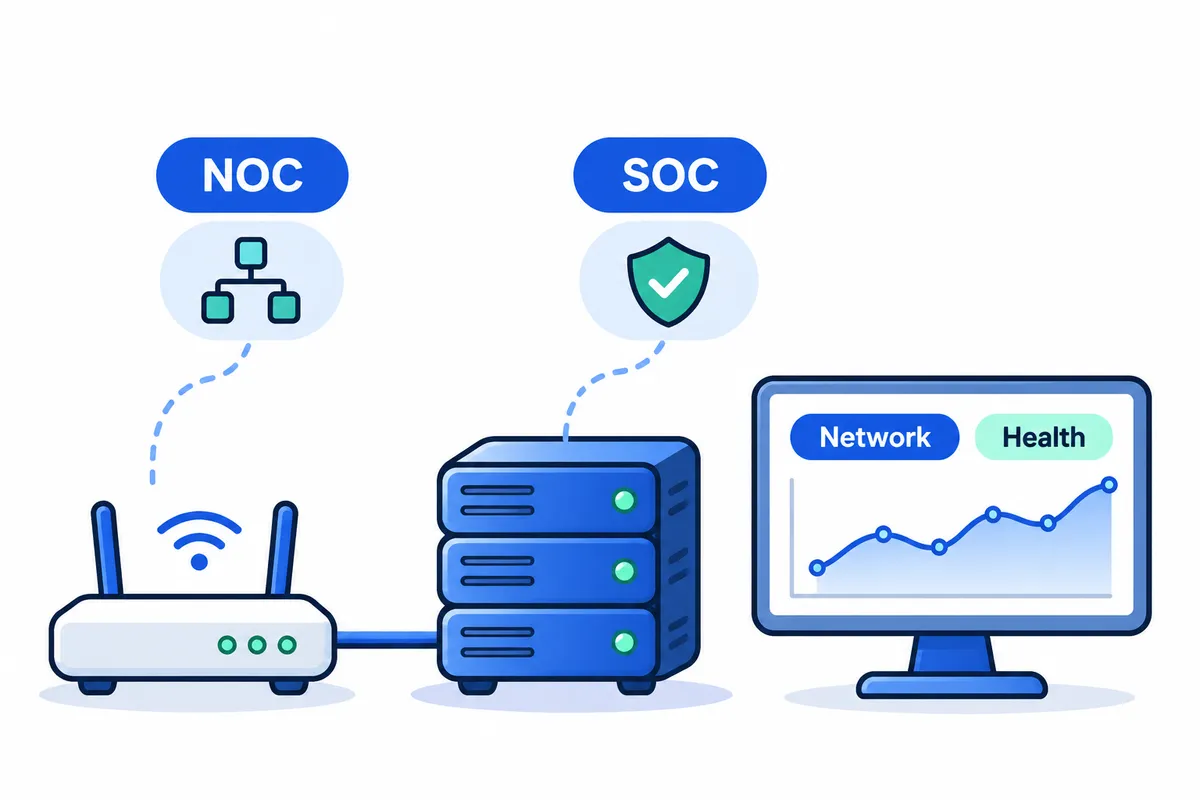
A network operations center keeps infrastructure available, tracks degradation and coordinates service restoration after a failure. Engineers connect device-level signals to service impact: can users reach the application, and is the network supporting it properly?
The supporting guides linked below come from 24Observe, built by our group, so weigh our view accordingly.
Availability: check whether services and infrastructure are reachable
The NOC watches connectivity and equipment health across infrastructure that can include servers, routers and firewalls. Uptime monitoring checks whether a monitored endpoint responds. Website availability checks help assess the service users actually access.
Each check answers a different question. A router can respond while an application behind it remains unavailable. Before choosing where to investigate, engineers should compare service failures with interface status, routing conditions and host health.
Firewall duties need clear ownership. A NOC may troubleshoot device availability or a failing connection. Changes to permitted access require coordination with the SOC and the authorized security-policy owner.
Performance and capacity: find degradation and plan for demand
A service can be available yet slow or unreliable. NOC engineers track bandwidth consumption, latency and packet loss alongside equipment health. A reachable device may still struggle because of processor pressure, exhausted memory or interface errors.
Compare current conditions with normal behavior. Is bandwidth demand rising steadily? Does it peak during backups, or is the increase confined to one branch? Check whether packet loss coincides with saturation. The distinction between monitoring and observability applies here: an alert identifies a condition, while investigation requires supporting evidence, including operational logs.
Use those traffic patterns to guide capacity decisions. Repeated congestion during business-critical periods may justify additional bandwidth or infrastructure changes. Rescheduling may be enough for a short, predictable backup peak. Recommendations should account for growth and peak demand, including the capacity needed if a primary connection fails. Average utilization alone cannot support that decision.
Maintenance and change: prepare infrastructure and recovery procedures
NOC duties vary by organization. Some teams handle software updates, hardware maintenance, configuration backups and recovery planning. In others, platform, network or dedicated backup teams own those tasks. The NOC monitors execution and escalates failures. Make that division of responsibility explicit.
We recommend recording the affected service, approval and planned work in the change record, along with verification steps and rollback conditions. Before work begins, prepare a usable configuration backup and confirm who can authorize reversal. Treat these as recommended operating practices, with change-management ownership assigned according to the organization.
Recovery planning also needs to specify backup locations and access permissions, along with how restoration will be tested. Keep runbooks accessible. Include pending maintenance and unresolved risks in on-call handovers.
Incident restoration: confirm impact, recover service and verify
Consider a hypothetical branch connectivity failure:
- Confirm the symptom. An availability alert fires, and branch users report application failures. Check from the affected location and another network to establish the scope.
- Narrow the fault by comparing connectivity and packet loss with interface state and router health. Review recent changes. Contact the carrier if the evidence points toward its circuit.
- Choose an authorized recovery action. Suppose the primary circuit appears unstable and a secondary path is available. Follow the approved failover procedure, preserving relevant logs and observations.
- Verify restoration by confirming application access from the branch. Check latency and loss, and ensure the alternative path can carry the traffic. Record actions and results in the incident timeline.
Successful failover confirms that the alternative path works. The reason for the primary circuit’s failure still needs investigation. Record restoration time separately from that follow-up work, and clearly mark unverified explanations as hypotheses.
What tools does a NOC use to monitor network health?
A NOC combines device monitoring, performance measurements, service checks, logs and incident coordination, each supplying different evidence. The practical distinction between monitoring and observability is whether engineers can move from spotting a symptom to investigating its cause.
24Observe is built by our group, so weigh our view accordingly when using the linked references below.
| Tool category | Evidence collected | Operational question | Limitation |
|---|---|---|---|
| Network management systems | Device status, interface state, errors and resource usage | Which device or interface needs attention? | Device reachability does not establish service health. |
| Performance monitoring | Traffic rates, utilization, latency and packet loss | Where is performance deteriorating? | A threshold breach alone does not explain why. |
| Availability checks | Response success, response time and check location | Can this location reach the service? | A failed check identifies a symptom, not necessarily its cause. |
| Log analysis | Timestamped device, host and application events | What happened around the disruption? | Missing events or inconsistent clocks weaken investigation. |
| Incident coordination | Acknowledgments, ownership, escalation history and response notes | Who is responding, and what has been tried? | Coordination cannot compensate for missing telemetry. |
Read bandwidth, latency and packet loss together
Bandwidth utilization shows how much link capacity traffic consumes. Sustained high utilization during busy periods warrants checking queueing and capacity; a brief spike alone does not justify an upgrade.
Latency measures delay. Compare it with the normal range for the same path and measurement method. Higher latency alongside rising utilization suggests investigating congestion, but does not prove it.
Packet loss means some measured packets did not arrive. Check whether it affects application traffic or only monitoring probes, then compare interface errors and adjacent links before assigning a cause.
An uptime check timing out establishes that a request failed from that check location. That result alone cannot establish that a router failed. Corroborate it with interface measurements and timestamped events. Include log management in the evaluation so you account for how events will be collected, retained and reviewed.
Buy for coverage and investigation quality
Evaluate candidates against three criteria rather than dashboard count:
- Assess coverage of critical devices, links and services from relevant locations. Include website checks and API checks where those services matter.
- Check whether alerts identify the affected resource, measurement, timestamp and service impact. Test whether notifications help responders prioritize without adding alert fatigue.
- During evaluation, ask an engineer to connect a failed check, device event and performance change to one incident investigation. Verify ownership and escalation against your on-call process, and check whether timestamps support recovery-time measurement.
What does a security operations center do?
A security operations center protects systems and data by reviewing security events, assessing suspicious behaviour and coordinating action when evidence indicates a threat. Alongside incoming alerts, its work covers vulnerability discovery and proactive threat hunting.
The 24Observe SOC resources linked here come from a platform built by our group, so weigh our view accordingly.
Detection: find signals that deserve attention
Analysts review authentication records, endpoint activity, firewall events and application security logs. Security-event review looks for patterns such as repeated authentication failures followed by a successful privileged login, or an unexpected process launching on a server. A SIEM brings related events together for examination.
Threat intelligence adds context about malicious infrastructure, attacker techniques and emerging vulnerabilities. Any match needs corroboration before analysts can draw a conclusion.
Detection also involves proactive work. Vulnerability discovery identifies weaknesses for assessment and remediation, though finding a weakness does not establish exploitation. Threat hunting tests a hypothesis even when no alert has fired. For example, an analyst might investigate whether someone is using a service account interactively without authorisation.
Malware, phishing and ransomware fall within this remit. Analysts also need to account for alerts caused by legitimate administration or a misconfigured application.
Triage: establish severity and likely impact
Triage determines urgency and the next investigative step. Analysts ask:
- Which account, host or service is involved?
- Does it handle sensitive information or support a critical business function?
- What evidence supports the alert, and how reliable is it?
- Is harmful activity continuing, and what could be affected next?
Severity reflects the apparent threat; impact reflects the consequences for the organisation. Both assessments remain provisional while analysts gather evidence.
An unfamiliar address or unusual login warrants investigation, but VPN use, travel or an approved administrative task may explain it. Analysts should record that uncertainty and keep credible warnings under review, while remaining mindful of alert fatigue.
Investigation: test scope and possible causes
During investigation, analysts establish what happened, how it happened and how far it extends. They build a timeline and connect users with hosts and processes to test competing explanations. This includes checking whether access was authorised and execution occurred, then examining other systems for related activity.
For the hypothetical unavailable application, a failed availability check establishes disruption. Security escalation requires supporting evidence.
Malicious execution detected on its server, unexplained privileged changes immediately before failure, or file encryption accompanied by a ransom note would support escalation as a suspected security incident. An unfamiliar client address alone is insufficient. Analysts must connect the security evidence to the affected application and examine operational context, including recent maintenance or configuration changes.
Forensic evidence makes those findings defensible. Preserve original logs, relevant messages, endpoint artefacts and timestamps, and document how evidence was collected and handled. Where appropriate, capture volatile evidence before restarting or rebuilding a system. Keep observed facts separate from hypotheses, and record gaps that prevent a confident finding.
Response: contain, remove the threat and recover
Response playbooks should distinguish three activities:
- Containment limits further harm, for example by isolating an affected endpoint, restricting an account or blocking confirmed malicious traffic.
- Threat removal involves removing malicious software and persistence, revoking compromised credentials and addressing the weakness that enabled access.
- Recovery restores affected services from trusted sources. It also includes validating their operation and monitoring for returning malicious activity.
Disruptive containment requires on-call coordination with application, infrastructure and business owners. Isolating a shared server can interrupt unaffected services. Agree authority and emergency procedures beforehand so urgent action does not depend on improvised approvals.
Recovery checks should confirm both service health and security. Record containment, threat-removal and restoration milestones separately so recovery-time measurement keeps service restoration distinct from evidence that the threat has been removed.
Which SOC tools support detection and investigation?
A SIEM brings security records together so analysts can search activity, identify suspicious patterns and investigate related evidence. When evaluating a SIEM, start with the records your analysts need and the questions those records can answer. 24Observe is built by our group, so weigh our view accordingly.
Choose SOC tools according to the investigative questions your analysts need to answer. Each category serves a different purpose.
| Category | Investigative questions it helps answer | Where human interpretation remains necessary |
|---|---|---|
| SIEM and log management | Which accounts, hosts and activities connect? What happened before and after the suspicious activity? | Analysts must check chronology, missing records and whether correlated activity actually indicates compromise. |
| Endpoint detection and response (EDR) | Which process ran? What launched it, and what happened on the endpoint? | Administrative scripts can resemble attacker behaviour. Analysts need execution context and business purpose. |
| Threat-intelligence inputs | Does an address, domain or observed technique connect to reported malicious activity? | A match supplies a lead. Its age, relevance and independent corroboration determine its weight. |
| Firewall evidence | Which connection was permitted or denied? Which source, destination and policy were involved? | An allowed connection does not establish successful exploitation; a blocked attempt does not establish compromise. |
| Incident-response workflows | Who owns the investigation? What evidence, decisions and actions have been recorded? | Responders must assess impact, determine scope and approve appropriate action. |
Separate records, warnings and investigated cases
An event records an occurrence, such as a failed sign-in. An alert flags activity that meets detection criteria and needs assessment; it does not prove an attack. An investigated incident is a tracked case in which evidence has been reviewed, scope assessed and the disposition documented.
Owning a tool does not establish detection coverage. Useful detection requires relevant source data and evidence another analyst can review. Check that source logs arrive with usable timestamps and identity fields. Then test detection logic against representative activity and document the blind spots.
Sigma is a format for describing log-based detection rules. It is not a detection engine, and support varies between SIEMs. Before using a rule, check that the required data and field mappings are available, then validate it locally.
Define authority before automating response
Before automating response, agree on a response procedure that defines permitted actions, approval boundaries and recovery steps. A detection match alone does not justify isolating a host or disabling an account.
The 24Observe AI Analyst, for example, uses read-only tools to investigate. Its proposed response actions require review and approval. Analysts remain responsible for assessing the evidence and authorising consequential changes.
NOC vs SOC differences: goals, metrics, alerts, skills and tools
The main NOC vs SOC difference is the outcome each team is responsible for. A reachable service can still be compromised; a containment action can interrupt a healthy service. The linked guides provide more context.
| Dimension | NOC | SOC |
|---|---|---|
| Primary goal | Maintain reliable infrastructure and restore disrupted services. | Identify threats, investigate compromise and coordinate security response. |
| Protected outcome | Service availability and acceptable performance for users. | Protection against unauthorized access, data exposure and malicious activity. |
| Typical alert, hypothetical | “Branch connectivity is unavailable” or “application latency exceeds the agreed threshold.” | “Repeated authentication failures precede an unusual privileged login.” |
| Evidence examined | Traffic patterns, interface counters, device health, performance measurements and recent changes. | Authentication records, endpoint activity, firewall events and other security logs. |
| Initial investigation question | Which dependency failed or slowed, and which services are affected? | Does the evidence indicate malicious activity, and what identities or systems are involved? |
| Incident priority | Business-service criticality, disruption scope and operational impact. | Threat severity, evidence of compromise, affected assets and potential damage. |
| Metrics | Availability, latency and time to resolve operational incidents. | Response timing, detection performance and effectiveness of preventive or detective controls. |
| Technical skills | Routing, switching, connectivity diagnosis, capacity analysis and infrastructure troubleshooting. | Network interpretation, endpoint investigation, log analysis, threat hunting and incident response. |
| Tool categories | Network management systems and performance monitoring tools. | SIEM, EDR, threat-intelligence resources and investigation tools. |
| Handoff triggers | Unexpected access, suspicious traffic or unexplained changes warrant security investigation. | Containment affects connectivity, or recovery requires routing, device or service changes. |
Make the metrics defensible
NOC reports should specify the service being measured, the measurement window and the latency statistic. Define whether resolution means restoring service or completing a permanent repair. Those timestamps answer different operational questions.
SOC reports need separate timings for alert acknowledgment, investigation and containment. To report a detection rate, establish a defensible denominator, such as a defined set of simulated attack scenarios with known expected results. Record which scenarios were detected and the conditions and exclusions that apply. Production alert counts alone cannot tell you how many attacks were missed.
Assess each control against its intended purpose. For a preventive control, check whether it blocked the tested action. For a detective control, check whether it produced usable evidence. Track false positives separately when reviewing alert volume, since more alerts do not establish better detection.
Assign ownership by task
Both teams need a grounding in TCP/IP, DNS and routing, along with systematic troubleshooting skills. An analyst or engineer should be able to follow a connection and interpret its timestamps while keeping observations separate from assumptions.
A firewall shows why an equipment label cannot determine ownership: it carries production traffic and enforces security policy. Interface failures or routing problems may sit with NOC. Suspicious rule changes or unauthorized access may require SOC. Agree on response ownership before either team makes changes to the firewall.
Use the table to guide investigation priorities without treating it as a fixed division of responsibilities. The current risk should determine who leads. Keep both teams involved whenever restoration and containment decisions affect each other.
Where do NOC and SOC overlap during an incident?
NOC and SOC overlap when a service disruption has several plausible explanations and the response could affect both availability and security. An unreachable service could indicate a connectivity fault or an incorrect change. Hostile activity is another possibility, so the symptom alone cannot establish the cause.
Illustrative scenario, not a customer case: Continue with the unreachable application. An uptime check fails, and users report connection timeouts. Traffic rises at the network edge while firewall denies increase. The investigation needs to test competing explanations before classifying the incident as an attack or an ordinary outage.
Build hypotheses from observations
| Observation | Operational hypothesis | Security hypothesis | Evidence needed next |
|---|---|---|---|
| Service connections time out | A failed link, routing problem or incorrect configuration prevents access. | Deliberate disruption or an unauthorized change has affected access. | Check results from different locations, interface health, routing state, application logs and recent changes. |
| Traffic volume differs from its usual pattern | Legitimate demand, retries or a scheduled transfer is consuming capacity. | Flooding, scanning or unauthorized transfer activity is contributing. | Traffic direction, source and destination distribution, connection patterns, bandwidth history and workload schedules. |
| Firewall denies increase | An approved rule change is blocking legitimate requests. | Requests are hitting restricted paths, or someone altered policy without authorization. | Matched rules, configuration differences, administrator activity, change approval and affected connection details. |
These observations do not prove hostile activity. A blocked connection tells you that a control rejected traffic, without establishing the sender’s intent.
Suppose the teams then find a firewall change shortly before the failures. The timing warrants investigation, though it does not establish causation. Compare the configuration difference with the failed traffic path. Confirm who made the change and whether its scope matches the approval. Even an approved change can contain an implementation mistake.
Examine the same logs with different questions
Both teams can examine identical firewall and application records. Log management gives them shared evidence, which they approach with different questions:
- NOC: Which legitimate flows stopped working? Did the failures begin after the change? Are interface errors or resource constraints involved?
- SOC: Was the change authorized? Is the administrator’s activity expected? Do related authentication or endpoint events suggest a wider incident?
The NOC tests how the service failed. The SOC examines intent and authorization, then determines the scope of the security incident. Each team should account for the other’s findings.
Keep observations separate from interpretations in a shared timeline. The distinction between monitoring and observability helps frame this work: detecting a failure starts the investigation; explaining it requires context. A SIEM investigation adds security questions without making every anomaly malicious. Link related alerts to avoid duplicate escalation.
24Observe is built by our group, so weigh our view accordingly. Its SIEM and observability comparison explains why operational and security investigations can use overlapping evidence.
Coordinate restoration and evidence preservation
Restoration can change the evidence. Restarting a host may remove volatile state, while reverting a firewall policy may overwrite useful configuration context. Waiting has consequences too: users remain blocked, and suspected malicious activity may continue.
Neither team takes priority by default. Agree on a decision owner through the on-call process. Assess service impact and suspected compromise alongside the evidence at risk and the available alternatives.
Where feasible, preserve relevant logs and configuration differences before intervention, along with volatile evidence. Consider whether traffic can move to a known-good instance while the affected host remains isolated for investigation. If delay creates greater harm, authorize the necessary action and record what evidence may be lost.
For each change, record who approved it, what it was intended to do and when it occurred. After restoration, verify availability and continue checking the security scope. A better time to recovery does not, by itself, establish that the security investigation is complete.
How do you implement NOC SOC integration step by step?
Start by linking records and agreeing on procedures. Keep existing tools in place while you work out what information needs to move between teams. You can consider a common platform once those requirements are clear.
The sequence below is the Networkers Home editorial operating model. It carries no outcome guarantee, and individual platforms may not support every step. We include blog resources and documentation from 24Observe, which is built by our group, so weigh our view accordingly.
1. Define joint objectives and decision authority
Agree on the shared objective: restore service while controlling security risk and protecting investigation evidence. Document who can declare a joint incident, appoint its commander and approve emergency changes.
Keep incident command separate from specialist task ownership. The commander coordinates priorities, decisions and communications. A NOC engineer can own routing recovery while a SOC analyst owns compromise assessment. Neither specialist automatically commands the incident.
Name a deputy and an escalation authority to resolve disagreements between restoration and containment priorities.
2. Identify critical services and their owners
Begin with a manageable set of business-critical services. Record each service’s accountable owner, technical contacts, dependencies and recovery priorities.
Map dependencies beyond devices, including identity services, DNS, connectivity, applications and external providers. The observability guide provides background on connecting signals to service context.
For each service, establish who understands the business impact and who can authorize disruption. Identify who will validate recovery, and keep these contacts accessible during an outage.
3. Agree on shared evidence and entity identifiers
Define identifiers both teams will recognize: service name, environment, hostname, asset ID, cloud resource ID and user identity. Treat IP addresses as time-bound evidence rather than permanent asset identifiers.
Standardize timestamps, preferably in UTC, and distinguish event time from collection time. Agree on how responders will reference logs, alerts, queries and change records. See the log management guide for background.
Record observations separately from interpretations. “Authentication failures increased” is an observation; “credential attack” remains a hypothesis until evidence supports it. Set evidence-access permissions before an incident occurs.
4. Establish linked incidents or one common record
Choose a shared incident record or reciprocal links between existing NOC and SOC tickets. Specify where responders will find the authoritative timeline, decisions and ownership. A common record should make incident context accessible without requiring responders to copy every log entry.
Use this reusable handoff template:
| Field | Required handoff content |
|---|---|
| Affected service | Service, environment, impacted dependencies and business impact |
| Timestamps | First observed, last observed and latest update, with timezone |
| Symptoms | Observed failures, scope and relevant baseline |
| Evidence references | Alert IDs, log links, queries and preserved artifacts |
| Changes already made | Action, operator, time, approval and observed result |
| Security concerns | Indicators, exposure and unresolved hypotheses |
| Current owner | Incident commander and named specialist task owners |
| Next action | Task, assignee, approval needed and review time |
| Acknowledgment | Receiving responder, acceptance time and questions outstanding |
The sending responder remains accountable until the receiver explicitly accepts the transfer.
5. Define severity, escalation and handoff rules
Assess severity using business impact and security exposure. A service can remain available while a suspected compromise requires urgent action.
NOC should involve SOC when troubleshooting reveals unexplained privileged access, suspicious authentication, unexpected configuration changes, unusual outbound traffic or signs of malicious activity.
SOC should involve NOC when an investigation needs network context or containment could interrupt dependencies. Bring NOC in when recovery requires connectivity, routing or capacity changes.
Document acknowledgment targets, fallback contacts and the escalation path for unanswered handoffs. Use the on-call rotation guide when assigning coverage. Carry unresolved hypotheses into the handoff with both supporting and contradictory evidence; do not silently discard them.
6. Write coordinated restoration and containment procedures
For each scenario, specify prerequisites, evidence capture, containment options, restoration steps, validation and rollback. Keep response procedures where both teams can reliably access and maintain them.
Require an explicit approval path for disruptive actions such as host isolation, account disabling, route withdrawal, firewall changes or shutdowns. Identify the approver, deputy and emergency exception authority. Record each decision and its rationale.
Avoid restoring connectivity into a suspected compromise without security review. Containment proposals must also state the expected service impact. The commander resolves priorities through the agreed authority structure, and specialists execute their assigned tasks.
7. Test the process with simulations and joint training
Run tabletop exercises before moving to controlled technical simulations. Test a suspicious login followed by service degradation, then a compromised host requiring isolation. Include a network failure that produces overlapping alerts.
Introduce missing contacts, unavailable evidence and conflicting recommendations. Use alert volume as a stressor, and discuss how responders prioritize their attention when several alerts arrive together.
Train NOC engineers to preserve security evidence and SOC analysts to assess network dependencies. During exercises, check whether responders obtain approvals and acknowledge transfers. Observe whether they retain uncertainty as they work through the scenario, rather than treating completion as sufficient.
8. Review incidents together each week
Hold a weekly NOC-SOC review covering active incidents, technical weaknesses, failed handoffs and disputed decisions. Reconstruct the timeline from records rather than memory.
Separate investigation time from time spent waiting or coordinating between teams. Examine missing identifiers, repeated evidence requests and delayed approvals.
Give each improvement a named owner and due date. Update the service map, handoff template or procedure as needed, then retest the changed step in the next simulation.
Can one platform support both NOC and SOC? Assessing 24Observe
24Observe is built by the Networkers Home group. We disclose that connection so you can weigh our assessment accordingly. We assess it first because its common data store and shared incident system address a specific integration problem: NOC and SOC teams investigating related events through separate evidence and incident records.
That architecture makes it a candidate for teams seeking a common investigation workflow. Its suitability as a replacement for each existing tool still needs validation. The linked founder story explains the operational complexity behind the consolidation effort. It provides background; it does not independently establish effectiveness.
How documented capabilities map to daily work
Assess whether NOC operations and SOC operations can work from the same evidence while retaining their different responsibilities.
| Workstream | Operational task | Documented capability | What to validate |
|---|---|---|---|
| NOC | Detect service unavailability | Uptime probes check availability; failed checks enter the incident system used by other signals. | Whether checks represent the services and failure conditions your team needs to monitor. |
| NOC | Investigate device and connectivity problems | A collector polls network devices without requiring software on them. Network telemetry supports charts, trends and threshold alerts. | Device coverage, required measurements and visibility during a link failure. |
| NOC | Examine host health | Host metrics include processor, memory, disk and network measurements. Metrics and logs appear together in incident investigations. | Whether the collected measurements explain your recurring operational failures. |
| SOC | Search and interpret security events | Authentication records, web access records, firewall events and cloud events are normalised at ingestion. Log search uses a common query language across device, application and host records. | Parsing accuracy and preservation of fields needed for investigation. |
| SOC | Investigate detection matches | SIEM detection opens incidents that can be investigated using related events and supporting evidence. | Required detection logic, source dependencies and tuning needs. |
| Joint investigation | Connect an outage with potentially suspicious activity | The context graph associates hosts, user identities and IP addresses across incidents. Operational and security incidents share the incident system. | Whether entity links are correct and useful for the incident under review. |
The context graph supplies the associations described in the last row. Its scheduled context-building process draws from traces, logs, monitors, incidents, assets, on-call information and audit records. Traces feed the graph as ingested signals. Their presence does not establish that the platform can replace specialist application-performance or user-experience monitoring tools.
What the AI investigation actually does
The AI analyst uses read-only investigation tools to search logs, inspect metrics, explore entity relationships and retrieve recent changes. Its conclusions link to evidence so an engineer can examine the basis for a verdict.
During a joint incident, assess whether the analyst connects service symptoms with relevant device events, host measurements and security records. It can test hypotheses against telemetry. When the available tools cannot support a confident conclusion, it routes the incident to a human.
Assess the two controls separately. LLM use requires permission at the organisation level. Analyst-proposed response actions require human review and approval, and recommendations are never executed automatically. Read-only investigation access still requires a review of what information an enabled LLM workflow may process.
Where the boundaries matter
24Observe documents threshold-based alerting. It does not document machine-learning anomaly detection. A configured metric boundary can identify a condition requiring attention; learning a behavioural baseline and detecting deviations uses a different mechanism. An AI-generated explanation after an incident opens does not change what triggered the alert.
Validate detection coverage against your actual threat scenarios before relying on exhaustive SIEM functionality, user behaviour analytics or complete correlation across adversary techniques. A technique label alone does not demonstrate that a multi-stage attack can be reconstructed.
Own-perimeter deployment supports running the platform, including its analyst, within the organisation’s boundary. Teams with perimeter requirements should evaluate this deployment model alongside the organisation-level LLM setting and proposed model configuration. Decide on deployment location and permission to use an LLM separately.
Test evidence before consolidating
Use representative cases: a service outage, a network-device failure and a security detection involving an affected host. Confirm source ingestion and parsing, then check timestamps, entity associations and investigation citations. Examine whether the evidence supports each conclusion and whether uncertainty reaches a human.
Adopt the platform where those tests meet your requirements, and retain specialist tooling wherever source coverage, detection depth or investigation evidence remains insufficient.
NOC engineer or SOC analyst: which career path should you train for?
Choose based on the work you want to practise repeatedly. NOC training suits someone who enjoys diagnosing connectivity failures, explaining performance changes and keeping services running. If you prefer examining evidence, investigating suspicious activity and justifying security-response decisions, SOC training is the closer fit.
Both require disciplined troubleshooting, but they ask you to establish different things. A NOC engineer verifies that service has recovered. A SOC analyst determines what happened, which systems or identities were affected, and what response the evidence supports.
The supporting resources below include 24Observe, built by our group, so weigh our view accordingly.
Skills matrix: shared foundations and different practice
| Skill area | Shared foundation | NOC-specific practice | SOC-specific practice |
|---|---|---|---|
| Networking | TCP/IP, DNS, routing and traffic interpretation | Isolate connectivity faults, congestion and equipment failures | Interpret suspicious connections and possible paths between systems |
| Logs and time | Log review, timestamps and source identification | Connect device events with service degradation | Correlate authentication, endpoint and network evidence |
| Systems | Operating-system behaviour and service dependencies | Diagnose resource constraints and plan maintenance | Understand processes, accounts, permissions and endpoint alerts |
| Investigation | Form hypotheses and test them against evidence | Explain the fault and verify restoration | Use SIEM investigation to assess activity and scope |
| Decisions and records | Clear tickets, escalation and handover | Document changes, rollback conditions and service checks | Justify disposition, containment recommendations and unresolved questions |
A NOC learning plan should cover maintenance alongside troubleshooting. That means checking device health, reviewing capacity and validating changes. For SOC practice, add endpoint knowledge to log analysis and learn how endpoint detection and response evidence informs an investigation.
Try a NOC exercise with a verifiable restoration
In an isolated lab, introduce a connectivity fault, such as an incorrect route. Start with a user-visible symptom: one test host cannot reach a service.
Produce a fault report containing:
- Impact: which source, destination and service are affected.
- Evidence: addressing, route information, connectivity tests and relevant device events.
- Diagnosis: the fault hypothesis and the observations that support it.
- Restoration: the corrective change and a rollback plan.
- Verification: repeat the original test and check that another expected path still works.
Use network telemetry documentation to explore evidence sources. For additional reading, see the uptime-monitoring guide. When verifying restoration, distinguish reachability from application usability: a successful ping alone does not prove that the application is usable.
Try a SOC exercise that ends with a defensible disposition
Use authorised lab events involving repeated authentication failures followed by a successful login. Treat this as a hypothesis to investigate, rather than proof of compromise.
Build a timestamped incident timeline. Identify the account, source addresses and destination hosts, then examine available endpoint and authentication evidence. Assess the scope: does the activity concern one account and host, or do related events extend further?
Your disposition should explain whether the evidence supports malicious activity, expected behaviour or an unresolved finding. Include supporting observations and missing evidence, along with any proposed containment or escalation. Keep detection logic separate from your conclusion. Use the detection documentation and incident-record examples as references when working through that distinction.
Moving from NOC to SOC requires deliberate practice
NOC experience gives you useful habits: understanding dependencies, reading network events and testing competing explanations. You still need to develop security-investigation competence through deliberate practice.
Add endpoint process analysis, account-activity review, evidence preservation and response reasoning. Rework the same case with incomplete logs, explaining how the gaps change your confidence. When reviewing AI triage, check its cited evidence independently; use the AI Analyst documentation as a reference for that review. Practise recommending containment while identifying its potential service impact.
What to look for in training
Networkers Home was founded in 2007 by Vikas Swami. Our Cybersecurity course includes a 49-scenario practical block using 24Observe.
Learners examine logs from real devices and normalize the events before applying detections and reviewing AI-generated triage. They then submit their incident disposition. In your own practice, make the reasoning behind each disposition explicit.
We also run a separate AI SOC Analyst course. Before choosing a path, compare the actual lab tasks and assessment criteria with the work you want to practise: restoring services, investigating security evidence, or building capability across both.
How do you measure whether NOC and SOC integration is working?
Measure incident handling before and after workflow changes, keeping service recovery separate from investigation quality. The linked 24Observe resources come from a product built by our group, so weigh our view accordingly.
Establish a baseline before changing procedures. Record timestamps, ownership changes, handoff contents and closure evidence. Compare incidents with similar severity, affected services and technical complexity. A timing difference alone does not establish better coordination.
Use this checklist in weekly joint reviews:
| Measure | What to examine | Basis |
|---|---|---|
| Service restoration time | Measure disruption to verified recovery. Use a consistent clock definition when comparing MTTR across similar incidents. | Established NOC responsibility |
| Security-response timing | Track detection, triage and containment separately; examine whether severity guided the security response. | Established SOC responsibility |
| Acknowledgment | Measure alert-to-owner acceptance, including delays across on-call handovers. | Proposed process diagnostic |
| Reassignment loops | Count transfers back to previous owners and record why the handoff process stalled. | Proposed process diagnostic |
| Missing handoff evidence | Flag transfers lacking relevant logs, affected assets, actions taken or an explicit next owner. | Proposed process diagnostic |
| Repeated alerts | Count repeat notifications per incident and distinguish new evidence from alert noise. Keep the counting method consistent across the incidents being reviewed. | Proposed process diagnostic |
Faster closure alone can hide an incomplete investigation. Where availability and security overlap, require separate checks:
- For operational restoration, confirm service availability and acceptable performance, with evidence and a named verifier.
- For security disposition, record the conclusion, investigated scope, supporting detection evidence, containment status and unresolved questions. Operational recovery must not automatically satisfy this check.
Clarify responsibilities first. Test a shared incident workflow through a simulation and comparable incident reviews, then evaluate tools against the evidence gaps you find. Before changing platforms, distinguish missing telemetry or inaccessible records from unclear ownership.
Frequently asked questions about NOC and SOC
What is the main difference between a NOC and a SOC?
A NOC keeps infrastructure available and services reliable; a SOC investigates suspicious activity and coordinates security response. NOC engineers check connectivity and device condition, then assess performance. SOC analysts examine security evidence to determine the scope of an incident and recommend containment. Uptime monitoring and SIEM analysis answer different questions, even when both teams examine the same system.
Can NOC and SOC responsibilities sit within the same team?
Yes, provided operational ownership and security authority remain explicit. A combined team needs named people responsible for restoring service and investigating suspected attacks. It must also be clear who can approve disruptive actions, including isolation or recovery. Document these responsibilities in the incident plan and on-call arrangements, even when everyone shares a reporting line.
What tools do NOC and SOC teams use?
NOC teams use network and performance monitoring; SOC teams use SIEM and EDR tools for investigation and response. 24Observe is built by our group, so weigh our view accordingly. It brings network monitoring, log management, metrics, availability checks and security detection together. When evaluating tools, check whether they provide the evidence each team needs and support its workflows. A shared dashboard alone does not establish that coverage.
Can a network outage also be a security incident?
Yes, a service disruption can have operational and security dimensions, though an outage alone does not establish an attack. NOC engineers should investigate service impact while SOC analysts examine suspicious activity and affected assets. Use a shared incident record to coordinate the investigation and preserve relevant logs. An alert warrants investigation; confirming compromise requires evidence.
How should an organization integrate its NOC and SOC?
Start with a joint incident plan that assigns responsibility for investigation and restoration, along with containment and approvals. Agree on escalation criteria and the evidence required for a handoff. Use shared response playbooks and hold weekly incident reviews. Practise mixed operational-security scenarios to test coordination. Address visibility gaps between monitoring systems, then check whether both teams can make decisions without duplicating work or losing evidence.
How should I prepare for a NOC or SOC career?
Build networking and troubleshooting fundamentals for either path. NOC preparation should include connectivity diagnosis and performance analysis. For SOC work, add endpoint investigation and log analysis, then practise incident response. Choose training that requires practical evidence review and written incident decisions. Our Cybersecurity course includes labs using device logs, detection and AI-assisted triage; assess that content against the skills you need.
Can AI replace NOC engineers or SOC analysts?
AI can assist investigation, but people retain responsibility for consequential decisions. 24Observe’s AI Analyst examines telemetry through read-only tools and cites supporting evidence. When it cannot reach a sufficiently supported conclusion, it passes the uncertainty to a human. Its response recommendations require approval before execution. Analysts remain responsible for scrutinizing evidence and distinguishing alerts from confirmed compromise, including judging the operational consequences of containment.
Frequently asked questions
What is the main difference between a NOC and a SOC?
A NOC concentrates on keeping infrastructure and services available and performing as expected. A SOC concentrates on finding, investigating and responding to security threats. Their evidence often overlaps: network events, system logs and firewall activity can matter to both teams. The difference is the primary question they investigate, whether service is functioning correctly or whether activity threatens the organization.
Can the same team handle NOC and SOC responsibilities?
An organization can assign both responsibilities to one team, but it still needs distinct operational and security workflows. Restoring connectivity and investigating possible compromise require different decisions, evidence and authority. Define who leads each task, when another specialist must become involved and who approves disruptive actions. A combined structure should retain both skill sets and clear accountability rather than treating monitoring as one undifferentiated job.
What tools do NOC and SOC teams use?
NOC teams typically work with network management and performance-monitoring tools to examine availability, bandwidth and latency. SOC analysts use SIEM systems, endpoint detection tools and threat intelligence to investigate suspicious activity. Both need access to relevant logs and incident records. Evaluate tools by the evidence they provide and the workflows they support, rather than assuming that a dashboard supplies a complete investigation.
Can a network outage also be a security incident?
Yes. Availability problems and security concerns can overlap, but an outage does not establish that an attack occurred. Teams should investigate operational explanations alongside relevant security indicators. Compare affected services, network conditions, logs and recent maintenance activity. If suspicious evidence appears, coordinate restoration with investigation and containment so that one team's actions do not unnecessarily disrupt the other's work or remove useful evidence.
What does NOC SOC integration involve?
Integration means coordinating evidence, incident ownership and response decisions across the two functions. Start with agreed escalation triggers, a consistent handoff record and clear authority for restoration or containment. Shared analysis can reduce the gaps created by isolated tools, but procedures still matter. Joint training, simulated incidents and regular reviews help teams test whether their responsibilities and handoffs work as intended.
How can a NOC engineer prepare for SOC analyst work?
Keep the networking and troubleshooting foundation, then add security-log analysis, endpoint knowledge, threat investigation and incident-response practice. Work through exercises that require a timeline, a scope assessment and a justified incident disposition. Understanding how services normally behave is useful context, but security work also requires testing competing explanations and documenting evidence. Choose training by its documented practical work rather than assuming a course guarantees a role.
Can AI replace NOC engineers or SOC analysts?
AI can support investigation, but assistance should not be confused with response authority. In 24Observe, the analyst examines telemetry through read-only tools and presents supporting evidence. Proposed response actions require human approval, and uncertain investigations can be passed to a person. Teams still need people to validate conclusions, assess business impact and authorize changes or containment. Evaluate the evidence and control boundaries behind any automation claim.